

A sync licensing scam is currently making its way through the independent music community, and it’s one of the most convincing I’ve seen in over a decade in this industry. Musicians are receiving fake emails that impersonate well-known sync agencies like Position Music, Marmoset Music, and Massive Music — complete with official-looking branding, real industry terminology, and follow-up phone calls. The scam ends with a request for an upfront “administrative fee” to clear a song for a placement that doesn’t exist.
I’ve personally been receiving these emails for months. Multiple members of my sync licensing community, CTRL Camp, have reached out asking me to verify whether the offers were real. This week, one member called me right before they were about to send money.
This article breaks down exactly how the scam works, the red flags to look for, what to do if you’ve already been affected, and how to protect yourself going forward.
Key Takeaways
- Scammers are impersonating real, reputable sync companies like Position Music and Massive Music
- The emails use correct sync licensing terminology, making them highly convincing
- The scam escalates to phone calls and fake licensing agreements that include an upfront fee
- No legitimate sync agency or publisher charges musicians an upfront fee to clear or place music
- Always verify the sender’s email domain, go directly to the company’s website, and ask someone you trust before signing anything
How the Sync Licensing Scam Works
Musicians are receiving emails that appear to come from real, well-known sync licensing companies. So far, I’ve seen versions impersonating Position Music, Marmoset Music, and Massive Music — all legitimate, respected companies in the sync world.
That’s what makes this so dangerous. These aren’t made-up company names. These are real companies that people in our world actually submit to. If you looked them up, you’d find real websites, real catalogs, and real placements. The scammers are betting on exactly that.
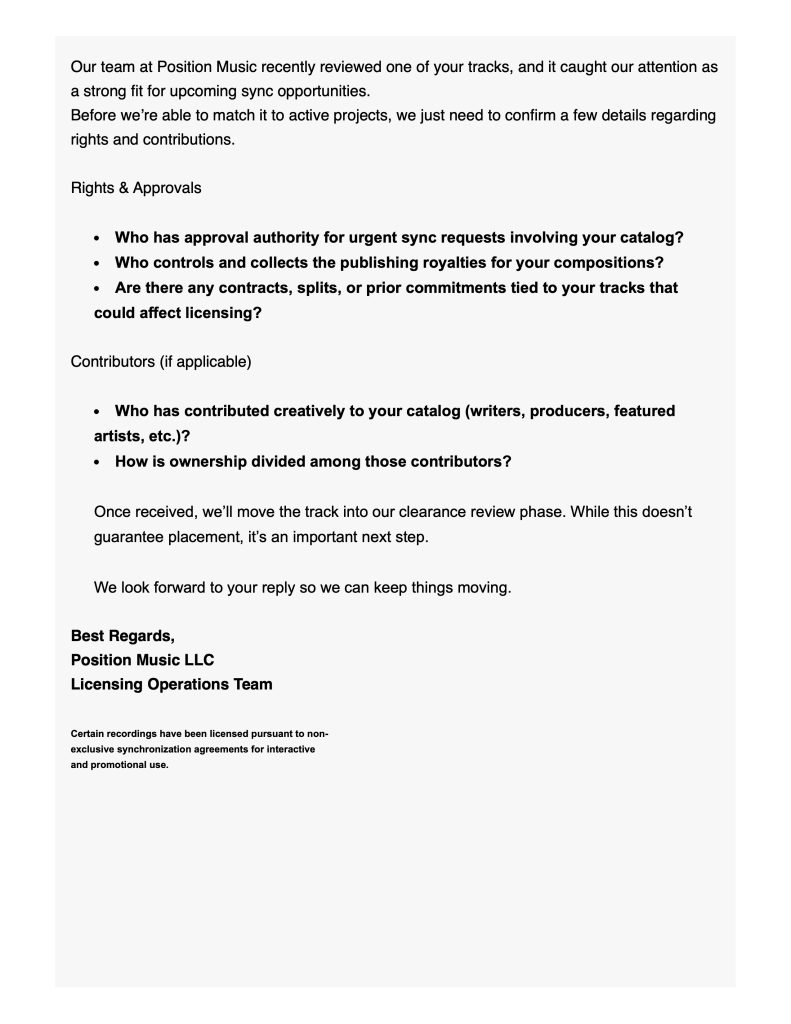
The Initial Email
The emails congratulate you and say their team has reviewed one of your tracks for an upcoming sync opportunity. Then they ask you to verify your ownership and rights information — who controls the publishing, whether there are any existing contracts or splits, and who contributed creatively to the song.
If you work in sync, those questions sound completely normal. Clearance verification is a real part of the licensing process. That’s what tells me the people running this scam actually understand how sync licensing works. The language is right. The process feels right. And that’s exactly why it’s fooling people.
The Phone Call and the Fake Licensing Agreement
I spoke with a community member this week who actually responded to one of these emails. Here’s what happened next: someone called them the following day. On the phone. To “verify ownership” and “talk through the terms.” After that call, they received what looked like a real licensing agreement.
Everything looked official. Except for one clause.
The agreement included an “administrative fee” to cover the cost of clearing the song. And they promised the fee would be refunded once the placement was secured.
That’s the scam.
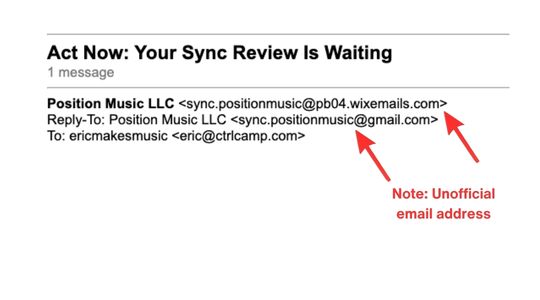
That’s your first red flag. Also, the Reply-To goes to a gmail account – not positionmusic.com – 2nd red flag.
5 Red Flags That Identify a Fake Sync Placement Email
Once you know what to look for, this scam doesn’t hold up. Here are the specific signs.
1. They Never Mention the Specific Song
Every version of this email I’ve seen says “your track caught our attention” but never names which track. And most of the people receiving this never submitted to these companies in the first place. If a real company reviewed your music, they would tell you exactly which song they’re interested in.
2. The Email Address Doesn’t Match the Company
The display name might say “Position Music LLC” or “Massive Music,” but the actual sender address comes from a Wix domain, a generic Gmail, or some other platform that has nothing to do with the real company. For example, one email I received came from sync.positionmusic@pb04.wixemails.com. Another came from licensing.massivemusic.gmail.com@syncmassivemusic.com. Neither of these is a real company domain.
Always check the full email address — not just the name that shows up in your inbox.
3. The Email Body Is Identical Across Every “Company”
I’ve now seen versions from at least four different company names, and the body text is nearly word for word the same. A real licensing inquiry would be specific to that company’s workflow, not a copy-paste template. If you’re getting the same pitch under different brand names, that’s not a coincidence.
4. They Ask for an Upfront Fee
I’ve been in the sync licensing industry for over a decade. I have never — not once — seen a real sync agency or publisher ask an artist to pay an upfront “administrative” or “clearance” fee. That is not how this works.
If a company wants your music, they take a commission on the back end when your music earns money. Period. Any request for payment before a placement happens is a clear sign you’re dealing with a scam.
5. The Agreement Is Tied to One Specific Placement
Real sync agencies don’t sign a song to pitch it to a single opportunity. They sign it because they believe it fits their catalog and they can pitch it to multiple projects over time. No experienced agent or publisher is going to guarantee one specific placement — because they can’t. Nobody can. That’s not how sync works.
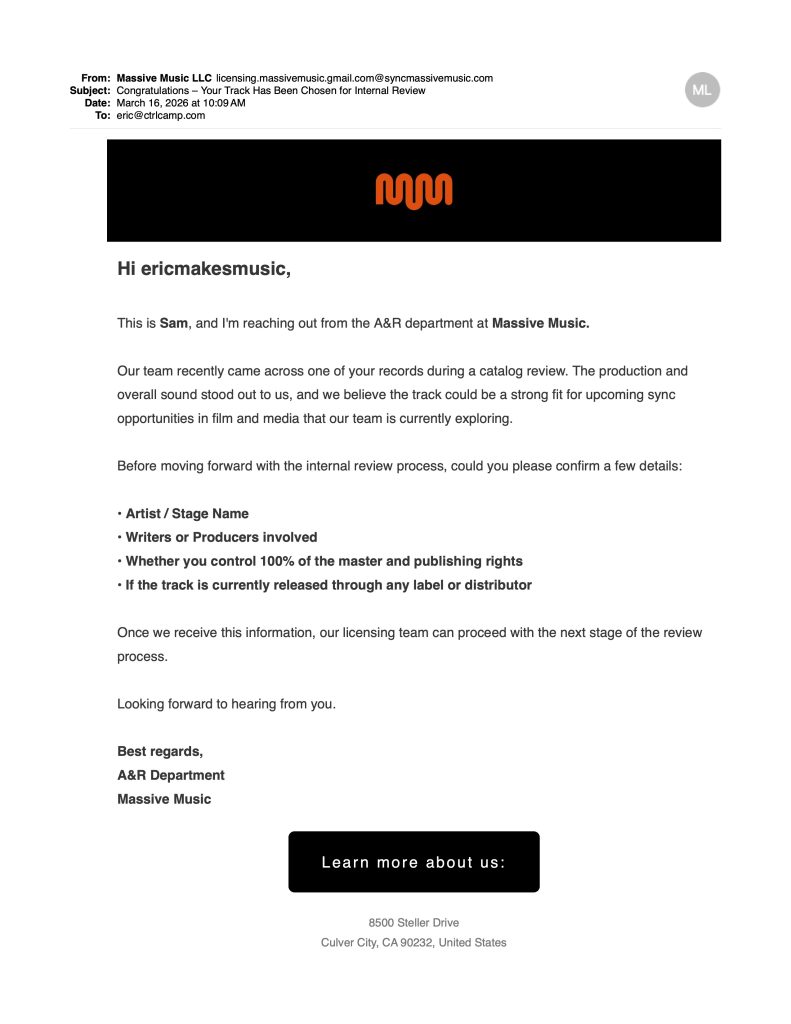
(no full name or contact given – red flag #3)
What to Do If You’ve Already Fallen for This Scam
If you fell for this, that is not something to be embarrassed about.
This is a sophisticated operation. It uses real company names. It mimics real industry processes. The people running it understand sync terminology well enough to sound credible at every step — the email, the phone call, the agreement. They’re designed to make you feel like everything is normal, because in a legitimate context, most of it is normal.
Research consistently shows that scam victims are not less intelligent or less careful than anyone else. A recent F-Secure study found that 69% of people said they could identify scams, yet 43% had still been victims in the past year. These operations are run by professionals who study the industries they target. They know what language to use, what emotions to trigger, and how to create urgency that bypasses your normal judgment.
And here’s the worst part: the shame around being scammed is often what stops people from telling others, which means the scam keeps spreading. Research has found that only about 7% of scam incidents get reported — largely because of embarrassment and stigma.
So if this happened to you, please don’t sit with it quietly. Tell someone. Report it. The only way we shut this down is by talking about it openly.
How to Protect Yourself From Sync Licensing Scams
- Always check the actual email address. Not the display name — the real sender address. If it’s a @wixemails.com, a @gmail.com, or any domain that doesn’t match the company’s official website, that’s your answer.
- Go directly to the company’s website. If you get an email from a company claiming they want to license your music, don’t reply to the email. Go to their official site and reach out through their actual contact page. If the opportunity is real, they’ll know about it.
- Never pay an upfront fee to get your music placed. Legitimate sync agencies, publishers, and music libraries do not charge artists upfront fees to clear, pitch, or place music. If anyone asks you to pay to get placed, walk away.
- Ask someone before you sign anything. If you’re not sure whether an opportunity is real, slow down. Run it by someone who has been through the process. A trusted community, mentor, or industry contact can spot red flags you might miss when you’re excited about a potential placement.
- Research the company before you respond. And not just a quick Google search. Understand how they operate, what kinds of deals they offer, whether they’re currently accepting submissions, and what their reputation looks like in the industry.
Why Having a Sync Community Is Your Best Protection
This scam taught me something I already knew but hadn’t fully appreciated: information alone isn’t enough. You also need people around you who know what real looks like.
Inside CTRL Camp, we’ve built the Sync Agency & Music Library Vault — detailed profiles on sync companies across the industry, including deal structures, submission policies, genre focus, and my personal insights on each one. There is nothing else like it at this level of detail in the entire sync licensing space.
But here’s what this scam exposed: the Vault alone isn’t enough. Because the companies being impersonated — Position Music, Marmoset, Massive Music — are real companies. If you looked them up in a directory, you’d see they’re legitimate. And that’s exactly what the scammers are counting on.
What you also need is a community of people who can verify what’s real in real time. Multiple CTRL Camp members have already reached out to me asking “Hey, is this company legit?” or “Does this email look right to you?” And every single time, we caught it before anything happened. The member who called me this week didn’t send the money. Because they had someone to call.
That’s the difference.
If you want to be properly informed about which sync agencies are worth your time, if you want access to deep research you can’t find anywhere else, and if you want a community of people — including me — that you can message before you sign something you’re not sure about, that’s exactly what we built CTRL Camp for.
Frequently Asked Questions
Do real sync companies ever reach out to artists by email?
Yes, it does happen. Sync agencies and music supervisors sometimes discover artists through streaming platforms, social media, or recommendations and reach out via email. The difference is that a legitimate inquiry will reference a specific song, come from an official company email domain, and will never ask for upfront payment.
Should I ever pay an upfront fee for a sync placement?
No. Legitimate sync agencies, publishers, and music libraries earn money by taking a commission when your music generates revenue from a placement. They do not charge upfront administrative, clearance, or registration fees. If someone asks you to pay before your music is placed, that is a red flag.
How can I verify if a sync licensing email is real?
Check the full sender email address, not just the display name. If the domain doesn’t match the company’s official website, it’s likely a scam. You can also go directly to the company’s website and contact them through their official channels to ask whether they sent the email.
What should I do if I already paid money to one of these scams?
Contact your bank or payment provider immediately to see if the transaction can be reversed. Report the scam to the FTC (reportfraud.ftc.gov) and to the real company being impersonated so they can warn others. And don’t be afraid to talk about it — the more visibility this gets, the harder it becomes for the scammers to operate.
Stay sharp out there.
– Eric Campbell
Eric Campbell, who releases music as the hip hop artist Prentice DaVinci, is a seasoned producer and songwriter with over a decade of experience licensing his music. He has secured hundreds of music placements. He is the founder of CTRL Camp, an education community focused on sync licensing for independent musicians, and sus3 Music, a sync licensing agency specializing in pitching ad-friendly hip hop and R&B.
| Whenever you’re ready, there are 3 ways I can help you: 1. Join CTRL Camp – Our Sync Community on Skool. You get access to our comprehensive Sync 101 course; Sync Playbooks which give you the best pitching strategy and The Agency Vault tells you who to pitch to. Just $10/mo 2 Join The Premium Tier – Inside Skool, upgrade to our Premium Tier and you get group coaching from Eric and personal feedback on every song that you create. $29/mo 2. NEW! VIP Tier – Includes everything in the premium tier plus hands on 1-on-1 help from Eric. Build and pitch your catalog in the fastest time possible with expert guidance. $99/mo |
There’s a movie starring Jason Statham called THE BEEKEEPER. It’s about how huge corporations have been set up to scam people. It’s an industry.
This is why scamming has gotten more sophisticated than just some hacker in his mom’s basement.
Good reference and it’s just a cool movie! Classic Statham.
Great movie and team behind the music *wink wink* lol