
Table of Contents
I want to talk about something that’s been bothering me for a while.
If you’ve ever searched for sync agencies or music libraries to submit to, you’ve probably come across the same thing I have – lists. Somebody posts a directory of sync licensing companies, maybe with names, websites, and an email address. And on the surface, that seems helpful.
But here’s the problem.
A list of email addresses doesn’t actually help you if you don’t know what kind of music those companies work with. It doesn’t help if you don’t know whether they’re accepting submissions right now, or what format they want them in, or whether they’re even a fit for your genre.
And yet, that’s what most people do. They find a list, they blast the same email to every company on it, and they wonder why nobody responds.
I’ve seen it happen over and over. Musicians spending hours writing cold emails to companies that were never going to be a match for their music in the first place. Not because the music wasn’t good — but because the approach was blind.
Cold emailing a sync company without knowing what genres they focus on, what types of placements they typically land, or how they prefer to receive submissions is like handing out your demo at a jazz festival when you make trap beats. You might get lucky. But you’re mostly wasting your time and theirs.
That realization is what pushed me to build something different.
The Vault of Sync Licensing Companies
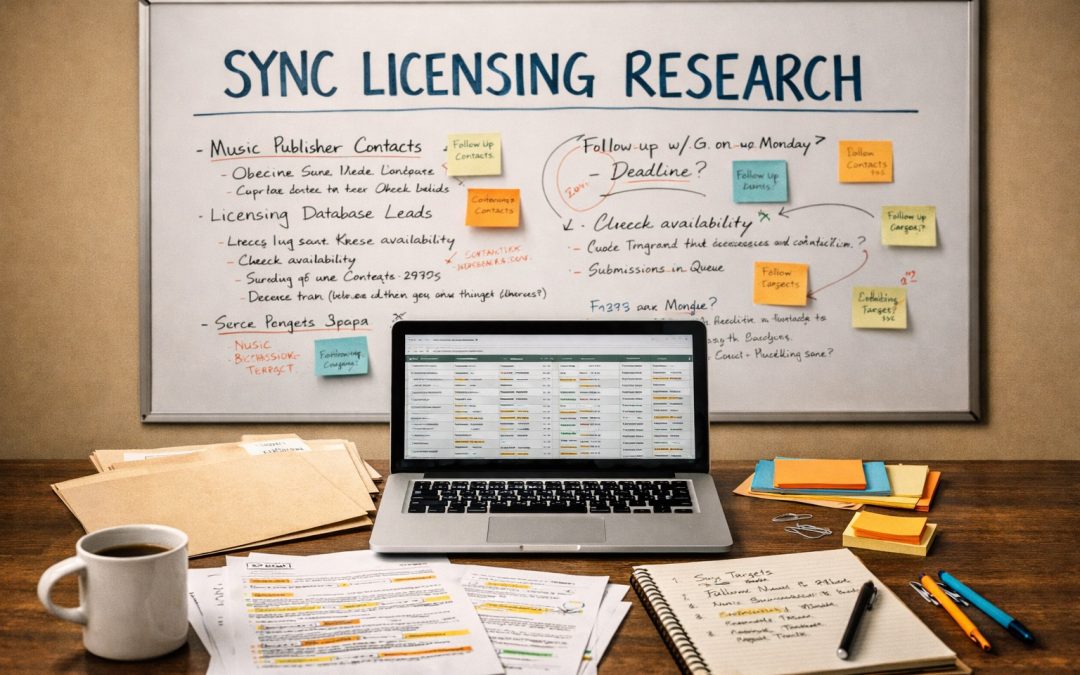
Inside CTRL Camp, I’ve been quietly building what I think is the most detailed research on sync licensing companies that exists anywhere right now.
It started in January with five companies. Today it’s at 15. And I expect it to be well over 50 by the end of the year.
I’m letting it grow at a pace that allows me to do the research the right way – because the whole point is depth, not just another list.
For every company in the Vault, I break down things like:
- What genres and styles they focus on
- What types of placements they actually land (TV, ads, trailers, promos)
- Whether they’re exclusive or non-exclusive
- Deal structures, commissions, and publishing splits
- How their submission process actually works
- My own insights from over a decade of working in this industry — including working with some of these companies directly
That last part matters. This isn’t just research I pulled from a website. A lot of what’s in the Vault comes from firsthand experience, conversations with people inside these companies, and years of watching how they operate.
The Range Is the Point
One thing I’m intentionally building into the Vault is range.
Right now, the 15 sync licensing companies include very different types of sync partners. You’ve got traditional sync agencies like Bodega Sync and Marmoset. You’ve got music libraries like 10 West Music and Crucial. Micro-sync platforms like Pond5 that work on a completely different model. And even newer tech-based hybrid offerings like AudioVybez and Push Audio that don’t fit into a typical sync agency box at all.
Each of these sync licensing companies operates differently. Their deals are different. Their submission processes are different. The types of artists they work with are different.
And that’s exactly why the Vault exists – so you can understand those differences before you reach out, instead of learning the hard way after you’ve already sent the wrong email.
Why I’m Taking My Time
I could’ve rushed this and thrown 50 sync licensing companies in there by now. But a surface-level profile isn’t any better than the lists that already exist online.
What makes the Vault valuable is the detail. When you open a profile, you should be able to answer the question: Is this company a fit for me and my music, and if so, what’s the smartest way to approach them?
That takes real research. And I’d rather give you 15 companies you can actually act on than 50 you still have to guess about.
If You Want Access
The Vault lives inside CTRL Camp, alongside the Sync 101 course and the Sync Licensing Playbooks.
Between those three things – the course that teaches you the language and the process, the Playbooks that help you identify your lane, and the Vault that tells you exactly who to pitch and how – I’m building the most comprehensive sync licensing resource that exists anywhere. More detailed than anything I’ve seen in over a decade in this space.
And it’s just $10 a month.
New sync licensing companies are being added regularly, and I have no plans to slow down. If you want to build a real sync strategy – one that’s based on research instead of guesswork — this is where it’s happening.
You can check out CTRL Camp here: https://ctrlcamp.com/skool
More soon.
– Eric Campbell
Eric Campbell, who releases music as the hip hop artist Prentice DaVinci, is a seasoned producer and songwriter with over a decade of experience licensing his music. He has secured hundreds of music placements. He is the founder of CTRL Camp, an education community focused on sync licensing for independent musicians, and sus3 Music, a sync licensing agency specializing in pitching ad-friendly hip hop and R&B.
| Whenever you’re ready, there are 3 ways I can help you: 1. Join CTRL Camp – Our Sync Community on Skool. You get access to our comprehensive Sync 101 course; Sync Playbooks which give you the best pitching strategy and The Agency Vault tells you who to pitch to. Just $10/mo 2 Join The Premium Tier – Inside Skool, upgrade to our Premium Tier and you get group coaching from Eric and personal feedback on every song that you create. $29/mo 2. NEW! VIP Tier – Includes everything in the premium tier plus hands on 1-on-1 help from Eric. Build and pitch your catalog in the fastest time possible with expert guidance. $99/mo |